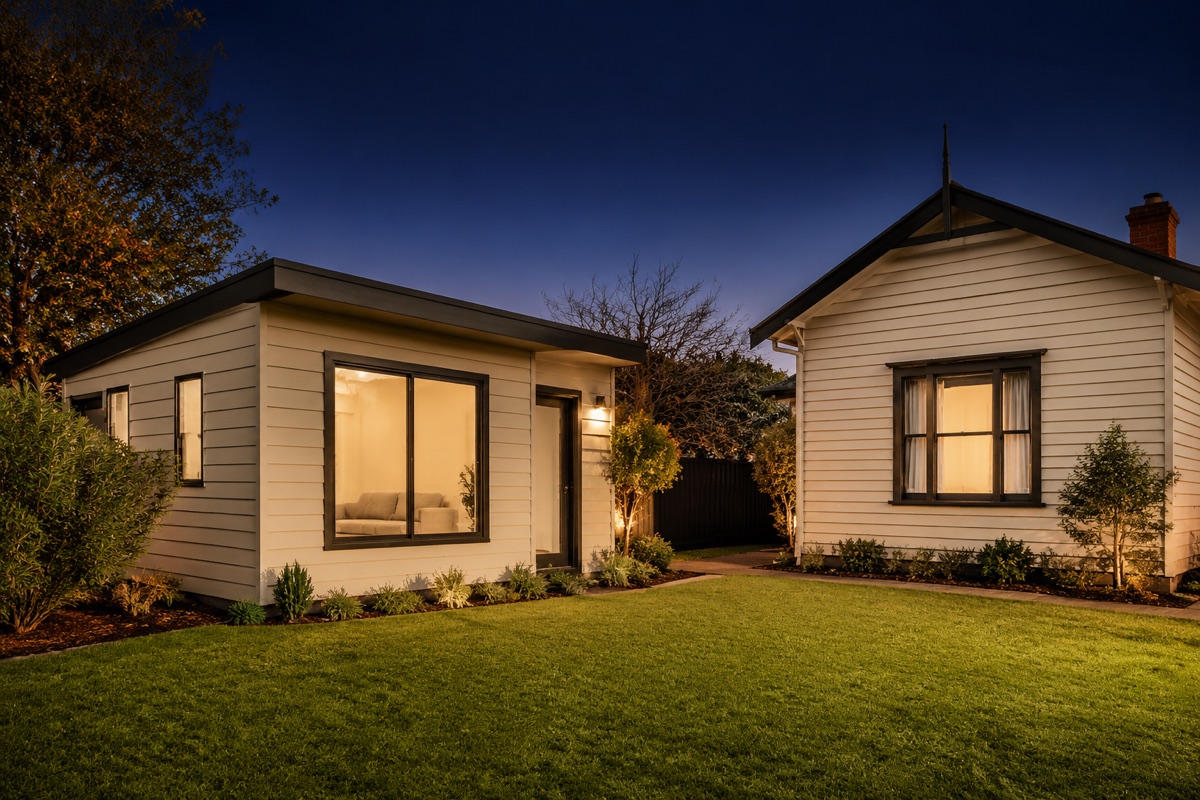
Why granny flat dual-living changed the Melbourne investment-property math
The single biggest shift in Melbourne residential investment over the past five years was not interest rates and it was not the apartment glut — it was a quiet planning reform. In September 2021 the Victorian Government, through Plan Melbourne and the Victorian Building Authority, removed the planning permit requirement for a Small Second Dwelling on the same title as a principal residence, provided the secondary dwelling is under 60 square metres of gross floor area, is sited within the building envelope, and meets the standard ResCode setback and overshadowing rules. Practically: if your block is a standard 500–650sqm suburban lot in Cranbourne, Boronia, Frankston, or Werribee, you can place a 55sqm two-bedroom granny flat in the backyard with a building permit only — no planning permit, no neighbour notice, no objections process.
The yield arithmetic this unlocked is the reason every serious Melbourne investor under 40 now asks about granny flats. A standard 3-bedroom house in the south-east corridor leases for around $550/week in 2026. Add a separately-leased 1-bedroom granny flat on the same title at $370/week and the combined rental income jumps to $920/week — a 67% lift on the same underlying land cost. That is the difference between a property that needs $400/month of owner top-up to service the mortgage and one that pays for itself with cashflow left over.
At OptimaRea we now manage 200+ tenants across the Melbourne metro area and a significant chunk of that book is dual-living. We have seen every flavour: detached granny flats, attached studio extensions, converted garages with kitchenettes, and full second dwellings with their own street frontage. Dual-living is our specialty, and it is the reason we charge a different fee schedule for it — more on that further down. First, the legal structure.
Separate leases vs single bundled lease — and why we ALWAYS recommend separate
There are two ways to legally lease a dual-living property under the Residential Tenancies Act 1997 (Vic). You can issue a single bundled lease covering both dwellings to one tenant household, who then sublets the granny flat. Or you can issue two completely separate leases — one for the main house, one for the granny flat — to two unrelated tenant households. OptimaRea recommends the second option every single time, with rare exceptions for multi-generational family arrangements.
Here is why. A single bundled lease looks operationally tidy: one bond, one condition report, one routine inspection. But it concentrates your risk in a way that becomes painfully obvious the first time something goes wrong. If the head tenant gives notice, the entire lease ends and you are re-marketing two dwellings simultaneously. If the head tenant is in the main house but the granny flat occupant is causing friction with neighbours, you have no direct contractual lever over the granny flat occupant. If rent arrears arise on either side, the entire bundle is in arrears and you are arguing about apportionment at VCAT.
Separate leases isolate every single one of those failure modes. Two separate leases mean two separate tenancies under the RTA 1997, two separate notice periods, two separate VCAT matters if it comes to that, two separate rent reviews, two separate routine inspection cycles. If your granny flat tenant gives notice you re-let the granny flat in 2–3 weeks while the main house keeps paying $550/week the entire time. Your cashflow continuity is fundamentally stronger.
The other underrated benefit is marketing optionality. With separate leases you can stagger the lease end dates — main house ending in March, granny flat ending in October — so you never have a quarter where both dwellings turn over at the same time. We deliberately structure renewals at OptimaRea to maintain a 6-month offset on every dual-living property we manage. That single staggering decision compounds into thousands of dollars of avoided vacancy over a 10-year hold.
Rent setting strategy: the $550 + $370 framework
The most common question landlords ask us before they commit to building a granny flat is: 'What will it actually rent for?' Based on the OptimaRea portfolio's empirical data across 2024–2026 leases, the granny flat rent typically lands at 60–70% of the main house rent on a per-square-metre basis, and at roughly 65–75% of the main house rent on an absolute per-week basis when the granny flat is approximately half the floor area of the main dwelling.
The variables that move the granny flat rent within that band are predictable. Bedroom count matters most — a 2-bedroom granny flat commands a 20–25% premium over a 1-bedroom in the same suburb. Separate entrance from a separate side gate or rear lane adds 8–12% versus shared front entry. Off-street parking adds $20–40/week. A small private courtyard or garden bed allocation adds $15–25/week. Natural light and double-glazing add another $10–20/week in cold-corridor suburbs like Boronia and Belgrave.
Three worked examples from properties currently under OptimaRea management:
- Cranbourne, 3-bed main house + 1-bed granny flat: main house leases at $560/week, granny flat at $360/week, combined $920/week. Pre-conversion single-tenancy rent was $580/week. Yield uplift: $340/week, $17,680/year gross.
- Boronia, 4-bed main house + 2-bed granny flat: main house leases at $640/week, granny flat at $480/week, combined $1,120/week. Pre-conversion single-tenancy rent was $660/week. Yield uplift: $460/week, $23,920/year gross.
- Frankston, 2-bed main house + 1-bed granny flat: main house leases at $510/week, granny flat at $350/week, combined $860/week. Pre-conversion single-tenancy rent was $540/week. Yield uplift: $320/week, $16,640/year gross.
The central recurring example we use with new clients is the $550 main house + $370 granny flat = $920/week combined, which represents the median outcome across the south-east and outer-east corridor. Whatever your block is doing, this is the number to triangulate from. We pull a comparable-rent report from CoreLogic and Domain feeds at the leasing strategy stage and we walk landlords through the rent recommendation in writing before either lease is signed.
RTBA bond logistics: two bonds, two lodgements, two condition reports
Each dwelling under a separate lease is its own tenancy, which means each one gets its own bond lodged separately with the Residential Tenancies Bond Authority (RTBA). For the standard sub-$900/week tenancy the maximum bond is 4 weeks rent. For tenancies at or above $900/week weekly rent the limit becomes 6 weeks rent, with that threshold reviewed periodically by Consumer Affairs Victoria.
In practice for our recurring $550 + $370 example: the main house bond is $2,200 (4 weeks × $550) and the granny flat bond is $1,480 (4 weeks × $370). Both get lodged separately through RTBA Online within 10 business days of receipt under section 411 of the RTA 1997, both produce a separate RTBA receipt number, and both are released independently at the end of each tenancy. The landlord never sees one combined bond.
The condition report rules apply equally and separately. Under section 35 of the RTA each tenant must be provided with a fully completed condition report at the start of the tenancy, and the tenant has 5 business days to mark it up and return it. We use PropertyMe at OptimaRea to document both dwellings independently — separate file numbers, separate photo sets (typically 60–90 photos per dwelling), separate floorplan annotations. We have learned from VCAT experience that mixing photos of the two dwellings into a single condition report is the single fastest way to lose a bond claim, because the tenant's lawyer will argue that ambiguity in documentation favours the tenant. Keep them clean and keep them separate.
Tenant screening: the two tenant pools are different
One of the most common mistakes first-time dual-living landlords make is assuming the same tenant filter that works for the main house works for the granny flat. It does not. The two tenant pools are demographically and behaviourally distinct, and screening priorities need to flex accordingly.
The main house tenant pool, particularly for a 3-bedroom in the outer south-east, is dominated by families — typically a working couple with one or two school-aged children. The screening focus for this cohort is income stability, length of previous tenancy (we want 18+ months in the prior place), rental ledger free of arrears, and at least two contactable references including the previous property manager.
The granny flat pool looks completely different. The applicants are most often: university students in their final or honours year (around 30% of our granny-flat lets), single working professionals aged 25–40 (around 35%), recently-separated individuals rebuilding (around 20%), and older downsizers in their 60s and 70s who sold the family home but want to stay close to grandchildren (around 15%). The screening priorities here are different — yes, income matters, but the bigger risk factor is compatibility with the main-house occupants. A granny flat tenant who works rotating night shifts is going to clash with a main-house family that goes to bed at 9pm. A violin teacher giving evening lessons is going to clash with primary-school kids studying.
OptimaRea's specific process: before we accept any granny flat application we pre-disclose to the applicant, in writing, who lives in the main house — household size, ages of children, occupations, work-from-home patterns, pet ownership. We then ask the applicant to describe their own routine in a short paragraph. About 30% self-select out at this stage, which sounds like inefficiency but is actually the single highest-leverage step in the entire process. The 70% who stay almost never produce noise or lifestyle complaints later. Our 1:50 manager:property ratio gives us the time to run this filter properly — most volume agencies running 1:200+ ratios cannot.
Shared infrastructure: driveway, bins, mailbox, parking
The granny flat is on the same title, on the same block, and physically connected by a shared driveway, shared rubbish collection point, shared mailbox, and often shared garden infrastructure. Every single one of those shared assets is a potential conflict point and we have seen them all.
Real complaints OptimaRea has handled in the last 12 months: main-house occupants parking a third car across the driveway and blocking granny flat access; kitchen-smoke drift from the granny flat through the main-house kitchen window because of prevailing wind direction; bin-stacking disputes where one household consistently fills the recycling bin and the other has nowhere to put their cardboard; mail going to the wrong dwelling because the granny flat occupant put their name on the main letterbox; a granny flat tenant attaching string lights to a shared pergola without permission; rubbish-collection day disputes about whose turn it is to drag the bins out.
The solution is the same in every case: written Special Conditions in each lease that pre-resolve the most common friction points before they happen. Our standard dual-living Special Conditions schedule, attached to each Victorian residential lease, allocates one specific parking space per dwelling (numbered on a diagram in the appendix), allocates designated bin slots, names the responsible party for bin-out and bin-in on collection day, sets quiet hours (typically 9pm–7am weekdays, 10pm–8am weekends), and prohibits unilateral modifications to shared assets including the garden, fence, and any structures within the building envelope. The Special Conditions framework sits within the standard Victorian residential lease template under section 27 of the RTA — it is enforceable, it has been tested at VCAT, and it is the single biggest source of operational peace on a dual-living property.
Utility splits: when the landlord pays vs when the tenant pays
Utility allocation is where dual-living gets technical and where most landlords get caught out. The general rule under Victorian residential tenancy law is straightforward: if a utility is separately metered to each dwelling, the tenant of that dwelling pays for their own consumption; if it is not separately metered, the landlord pays. The Victorian Government's Department of Energy, Environment and Climate Action (DEECA) sets the framework, with specific water-billing rules administered by Consumer Affairs Victoria.
Electricity: Modern dual-living builds, including effectively every Small Second Dwelling constructed since the 2021 reform, are designed with separate electricity meters from day one. The granny flat gets its own NMI (National Metering Identifier) and the tenant signs up directly with their preferred retailer. Sub-metering — where the granny flat draws from the main house meter and is sub-metered downstream — is permissible but governed by specific rules under the Electricity Industry Act 2000 (Vic). If sub-metering is the configuration, the landlord must use an accredited meter, must not on-charge more than the cost-pass-through rate, and must provide a clear breakdown on each bill. We strongly recommend genuinely separate meters wherever the budget allows.
Water: This is where landlords are most often surprised. Granny flats are rarely separately water-metered, because Melbourne's three retail water businesses (Yarra Valley Water, South East Water, Greater Western Water) install a single meter at the street boundary serving the entire title. Under the Residential Tenancies Act 1997 and DEECA's water billing rules, a tenant can only be charged for water usage if the dwelling is separately metered AND meets the water-efficiency requirements (3-star or better showerheads, dual-flush toilets, no leaking taps). If either condition fails — and on a shared title meter, it always does for the granny flat — the landlord pays the full water bill. For our $550 + $370 example property that is typically $1,400–$1,800/year of water charges sitting permanently on the landlord's side.
Gas: Most older Melbourne dual-living setups have a shared gas line. Newer builds increasingly omit gas entirely (heat-pump hot water, electric induction cooking). Where gas is shared, the standard OptimaRea approach is to convert the granny flat to all-electric at the next major appliance turnover and remove the dispute vector entirely.
Our core recommendation: always specify in writing in the lease who pays which utility, attach the meter configuration as an appendix, and never rely on verbal arrangements. We have seen too many tenancies sour over a $200 gas bill that nobody documented.
Maintenance: who calls the gardener?
Shared maintenance allocation is the operational layer that most volume agencies handle badly because it requires manager judgement and time. The landlord remains responsible under the RTA 1997 for all structural elements, all shared infrastructure, and all items that affect both dwellings — the roof, the fence, the driveway, the shared garden, the boundary trees, the stormwater system, the common-area lighting, the shared hot water service where applicable.
The day-to-day cleaning of common areas — sweeping the shared path, mowing the back lawn around the granny flat, keeping the bin area tidy — is typically allocated in the lease. Our standard practice is to engage one gardener under the landlord's account, paid monthly, and recover the cost through a small fortnightly garden-maintenance line item in each tenant's rent (split 60/40 main house to granny flat, reflecting the typical garden allocation). This avoids the dispute about whose turn it is to mow.
Maintenance triage at OptimaRea runs through Tapi, our tenant-side fault platform. Tenants log requests in 60 seconds with photos; the request lands with the relevant property manager, who classifies the issue as 'main house only', 'granny flat only', or 'shared infrastructure'. Shared infrastructure issues — a blocked stormwater pipe, a damaged roof tile, a sagging back fence — go to the landlord for approval and are dispatched to one of our preferred trades. Cost allocation policy: if a repair affects both dwellings, both tenants share the inconvenience for the duration of the work; the cost is entirely the landlord's. We do not on-charge maintenance costs across tenants for any shared item.
Why OptimaRea charges 6.90% + GST for dual-living vs 4.90% + GST for single
OptimaRea publishes a three-tier management fee schedule: 4.90% + GST for standard single-tenancy properties, 6.90% + GST for dual-living, and 8.90% + GST for multi-tenancy rooming-house or share-house configurations. The 200 basis point premium for dual-living over single is not a margin grab — it reflects a genuine doubling of operational workload.
Honest breakdown of the delta. A dual-living property requires two complete sets of all the core deliverables: two condition reports (each running 60–90 photos and a full room-by-room schedule), two routine inspection cycles per year, two bond lodgements with RTBA, two rent review cycles, two lease renewals, two notice-to-vacate processes if either tenancy ends, and two separate VCAT matters if either escalates. We dispatch maintenance trades to two dwellings on two different access routines. We mediate conflicts between the two tenant households — a workload that simply does not exist on a single-tenancy property. We allocate utility charges across two leases. We run two tenant screening processes when either dwelling re-lets.
The 200 basis point premium translates to about $1,500–$1,900 a year on the $920/week combined rent example. The post-conversion yield uplift on that same property is $300–$400/week extra, or $15,600–$20,800/year. The fee premium is recovered roughly 10× over by the income uplift. The real economic question is not 'is the 6.90% worth it' — it is 'can you find a property manager who can actually run dual-living properly'. Our 1:50 manager:property ratio means each manager has the time to handle the conflict mediation and operational complexity that dual-living demands. Volume agencies running 1:200+ ratios cannot, regardless of what they quote.
Specialist questions OptimaRea answers from dual-living landlord clients
1. Can I rent the granny flat to family — my mother, my adult child, a sibling? Yes, and many of our clients do, particularly for adult children saving for a deposit. Our strong recommendation: even when the granny flat tenant is family, issue a formal written lease and lodge a (typically nominal) bond. The formality protects everyone if circumstances change — death, divorce, a sale, a falling-out — and it preserves the granny flat's character as a rental income stream for capital gains tax purposes if the property is later sold.
2. Do I need a second landlord insurance policy? Almost certainly not a second policy, but you must check the dual-living wording on your existing policy. Some Australian landlord insurance products explicitly exclude properties with a secondary dwelling, others rate them as a single risk, and a small number require a specific dual-living endorsement. Call your broker before the second lease is signed and get the dual-living coverage confirmed in writing.
3. What about VCAT noise disputes between the two dwellings? OptimaRea mediates first. We have run hundreds of inter-dwelling mediations and the resolution rate without VCAT involvement is around 90%. The Special Conditions schedule referenced above gives us the contractual anchor for the mediation. VCAT is the fallback when mediation fails, and the relevant section of the RTA covering quiet enjoyment (section 67) applies independently to each tenancy.
4. Can the granny flat be Airbnb'd? Generally not advisable. Victoria's short-stay accommodation rules under the Owners Corporations and Other Acts Amendment (Short-stay Accommodation) Act 2018, combined with the 2024 short-stay levy of 7.5% on accommodation under 28 days, plus the operational friction of constant turnover next to your main-house long-term tenant, makes the net economics unattractive in almost every case we have modelled. Long-term residential leasing produces more reliable cashflow with a fraction of the management overhead.
5. We currently have a single bundled lease — when do we transition to two separate bonds and two separate leases? At the next lease renewal cycle, not mid-tenancy. Since the end-of-fixed-term Notice to Vacate was repealed on 25 November 2025, this can no longer be done by simply letting a notice run. The cleanest path is to negotiate the restructure with the existing tenant at renewal — a new agreement on the reconfigured premises, or a mutually agreed termination — then re-let the granny flat as a separate tenancy with its own RTBA bond lodgement, and either re-sign the main-house tenant on a new lease covering only the main dwelling or let the main-house tenant transition to a periodic month-to-month while you re-tenant the granny flat first. We walk landlords through this transition step-by-step and we have done it dozens of times — see our internal playbook in the OptimaRea granny flat rental management guide and the broader rental property management Melbourne guide for the wider framework that dual-living fits inside.
Talk to the OptimaRea team
OptimaRea is the specialist Melbourne property manager for dual-living, granny flat, and multi-tenancy investment properties. We manage 200+ tenants across the metro area, we hold a 1:50 manager-to-property ratio (versus the 1:200+ typical of volume agencies), and dual-living is our specialty rather than a side-line. If you are about to build a granny flat, are buying a dual-living property, or are running an existing dual-living property and want a property manager who actually understands the operational complexity — we should talk. For wider multi-tenancy setups including share-houses and rooming houses, see our multi-tenancy management guide. Phone the OptimaRea office or email leasing@optimarea.com.au and ask for Steven directly. First conversation is no-obligation, we will give you a frank read on your specific property in 15 minutes.