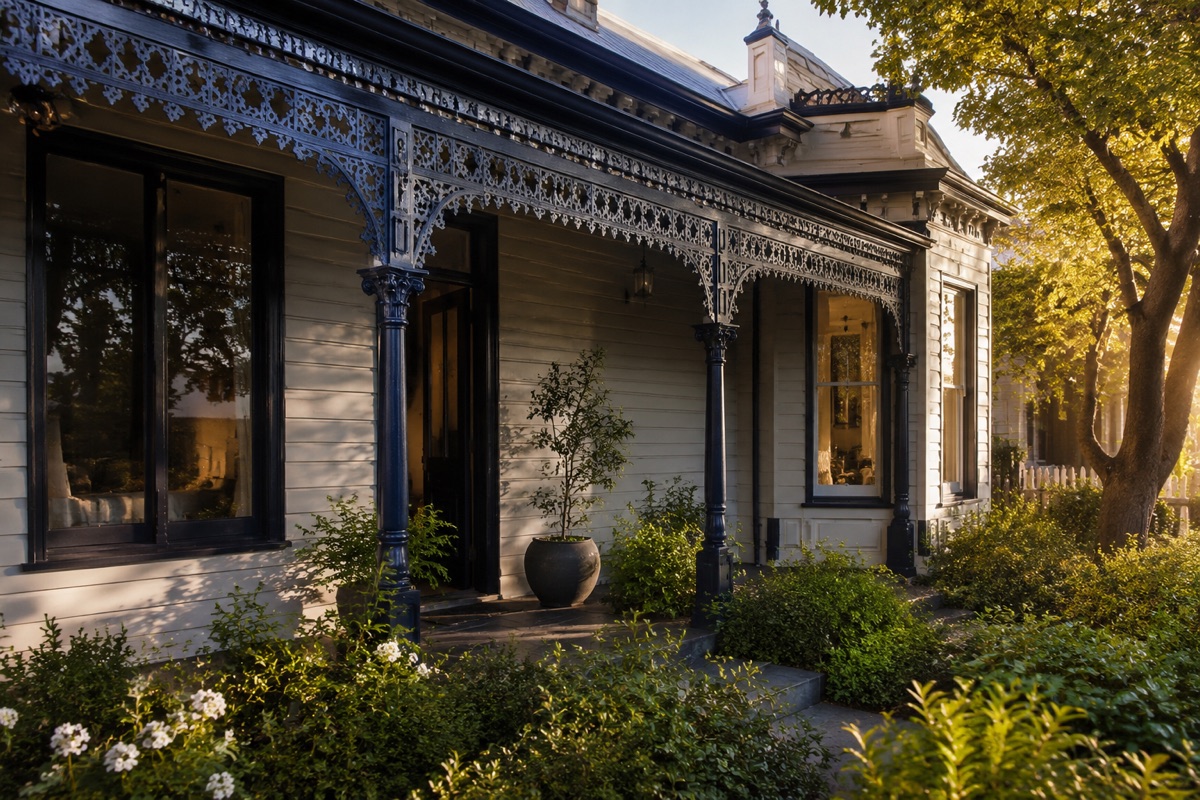
What the Heritage Overlay actually is — and how to tell if your property is in one
The Heritage Overlay (HO) is a planning control set under Clause 43.01 of the Victoria Planning Provisions, administered locally by each Melbourne council and overseen at the state level by Heritage Victoria. Roughly 85,000 Melbourne residential properties are currently mapped inside an HO precinct or carry an individual HO listing. Concentrations are heaviest in the inner suburbs: large sections of Fitzroy, Carlton, North Melbourne, Albert Park, South Melbourne, South Yarra, Prahran, Toorak, Armadale, Hawthorn, Kew, parts of Richmond and Collingwood, the inner streets of Brunswick and Coburg, plus most of Williamstown. Outer suburb HO listings exist but are sparser and tend to attach to specific buildings rather than precincts.
If you are buying or already own a Melbourne rental property, the first question to answer is whether it sits in an HO and, if so, which schedule applies. The Section 32 vendor statement is supposed to disclose this, but Section 32 disclosure failures happen — usually because the conveyancer searched only the title and missed the overlay on the planning certificate. The reliable check is to go directly to the Land Use Victoria free planning property report, enter the address, and look for any HO## reference in the planning scheme controls list. The schedule number matters because each council writes its own statement of significance and its own permit triggers — HO332 in the City of Yarra is a different beast from HO5 in the City of Stonnington, even if both apply to a Victorian terrace.
If the property is in an HO and the Section 32 failed to disclose it, that is a material misrepresentation under the Sale of Land Act 1962 (Vic) and you have grounds to negotiate or rescind pre-settlement. Post-settlement the remedies are harder but not impossible. Our broader rental renovation guide covers the search workflow and pre-settlement HO check for mid-purchase landlords.
What you can change without a planning permit — and what triggers one
The single most important practical distinction for a Heritage Overlay landlord is internal versus external. The HO is fundamentally about preserving the streetscape and the character of the heritage fabric visible to the public realm. It is far less concerned with what happens behind the front door.
Internal changes are almost always permit-free. You can rip out the 1980s laminate kitchen and install a new one. You can demolish and rebuild the bathroom. You can reconfigure internal walls (subject to building permit and structural engineering, not planning), upgrade the electrical wiring, replace the floors, paint the interior in any colour, install ducted heating and cooling, add ceiling fans, replace the hot water service. None of this needs a planning permit under the standard HO schedule because none of it changes what the street sees or what a heritage assessment would describe as the place's contributory fabric. Building permits and trades regulation through the Victorian Building Authority still apply in the normal way — the HO is a planning layer, not a building layer.
External changes are where the permit triggers cluster. The standard Clause 43.01 schedule requires a planning permit for: any building or works affecting the front elevation or any elevation visible from a street (including a laneway designated as a street); demolition or partial demolition of any contributory building; external painting of an unpainted masonry wall or repainting in a colour materially different from the existing colour; replacement of original windows, doors, verandas, fences, or roof materials with non-matching substitutes; any addition that is visible from the street; the construction of a new outbuilding, garage, carport, or secondary dwelling that is visible from the street; signage; and pruning or removal of canopy trees identified as contributory in the schedule.
The practical landlord interpretation: you can do almost any internal renovation without a planning permit. You cannot replace the original timber sash windows with aluminium without one. You cannot paint your unpainted bluestone facade without one. You cannot demolish the front fence and put up a Colorbond replacement without one. You cannot put a granny flat in the backyard if it pokes above the existing roofline as viewed from the footpath. The City of Melbourne, City of Yarra, City of Stonnington, City of Boroondara and City of Port Phillip all publish detailed council-specific heritage guidance — read the one that covers your property before you brief a builder.
Demolition is basically blocked — and what that means for renovation strategy
Under the standard HO schedule, demolition of a contributory or significant building requires a planning permit, and councils approve demolition permits in heritage precincts at roughly 5-10 percent of applications. The default position of every inner Melbourne council is that contributory heritage fabric is to be retained. Demolition succeeds only in rare scenarios: the building is structurally unsalvageable and an independent engineer's report confirms it, or it has been so heavily altered it no longer contributes to the heritage character, or the proposal is for partial demolition of a clearly non-original rear addition (e.g. a 1970s lean-to behind a Victorian double-fronted).
The operational implication for a landlord: do not buy a Heritage Overlay property with the plan of knocking it down and rebuilding. That plan will fail at council, fail at VCAT on appeal, and leave you holding an asset whose value is the existing structure plus the land — not the redevelopment potential of the land. The land-value-only acquisition strategy that works in non-HO middle-ring suburbs does not work in Fitzroy or Albert Park. The viable HO strategies are: retain and renovate at a premium standard, build a rear addition that is invisible from the street (single-storey rear extensions are routinely approved), or convert a contributory building to a higher-yield configuration internally (share-house, rooming house, dual-key) where the interior change does not trip a permit. The rent premium that HO properties command over non-HO equivalents — discussed below — is more than enough to make retention-and-renovation the economically rational move.
Granny flats and Heritage Overlay — usually blocked, sometimes possible
The Small Second Dwelling planning permit exemption introduced in 2021 — which made granny flats permit-free across most of suburban Melbourne provided the dwelling is under 60sqm and within standard ResCode envelopes — does NOT override the Heritage Overlay. If your property is in an HO and you want to build a granny flat, you are back in planning permit territory regardless of how small the second dwelling is.
The approval rate for HO granny flats hinges almost entirely on visibility. A 55sqm two-bedroom granny flat tucked behind a large Victorian terrace on a Fitzroy block, invisible from the street because the existing dwelling and side walls screen it, is routinely approved. Council heritage advisors are typically supportive provided the granny flat reads as a subordinate, contemporary addition and does not mimic or compete with the heritage character of the main dwelling. The recommended design language is clean modern — flat roof, contemporary cladding, simple massing — because that contrasts honestly with the heritage fabric rather than producing a fake-Victorian pastiche that would be refused.
The approval rate falls sharply when any part of the granny flat is visible from the street. A two-storey granny flat poking above the existing roofline of a single-storey workers cottage will be refused. A corner block where the side street view captures the new building will be conditioned heavily or refused. A proposal requiring removal of a contributory rear outbuilding will face heritage objections.
The step HO landlord clients consistently skip — and the one that materially changes outcomes — is the free pre-application heritage advisor meeting. The City of Yarra, City of Melbourne, City of Stonnington, City of Boroondara, City of Merri-bek and Port Phillip all run a free 30-minute heritage advisor consultation. Book the slot, take preliminary sketches, ask what would and would not be supported, and revise before you spend $8,000-15,000 on full drawings. We cover the operational mechanics of running a granny flat as a rental — separate leases, separate bonds, tenant pool differences — in the dedicated granny flat rental management guide.
Solar panels, air conditioning, hot water — case by case
Three modernisation items come up on almost every HO landlord renovation: rooftop solar, split-system air conditioning, and heat-pump hot water. Each is treated case-by-case under the standard HO schedule rather than being explicitly permitted or prohibited.
Solar panels mounted on a non-visible roof slope — typically the rear face of a hip or gable roof, not visible from the street — are routinely approved across every inner Melbourne council. The same panels mounted on the front slope, visible from the footpath, are usually refused unless the application includes a heritage impact statement showing the panels are low-profile, dark-frame, set back from roof edges and arguably reversible. The practical workaround is design-around: locate the array on the rear pitch, accept a 10-20 percent reduction in annual yield, and avoid the refusal entirely. The economic loss from suboptimal orientation is usually under $200/year on a 6.6kW system in Melbourne.
Split-system air conditioning condenser units mounted on a visible elevation almost always need a permit and are often conditioned. The standard approval condition is ground-mounted in a discreet location (side passage, behind a fence, screened by planting), painted to recede, and not on the front or street-facing facade.
Heat-pump hot water replacing an old gas storage unit is the easiest of the three. The replacement is almost always invisible from the street (in the side passage where the old gas unit lived), the heritage character is not affected, and councils approve these routinely or treat them as exempt. The Victorian Government's gas-to-electric transition policy means most of our HO clients are switching over the next five years, and we have not seen a heat pump approval refused in our portfolio in 2024 or 2025.
The meta-rule: visible from the street triggers a heritage permit; not visible from the street usually does not. Brief tradespeople accordingly and brief them before they arrive, not after they have started drilling brackets into a 140-year-old facade.
The 25-40 percent renovation cost premium — where the money actually goes
Renovating a Heritage Overlay property costs 25-40 percent more than the equivalent renovation on a non-HO property of comparable size and condition. This is the single biggest piece of financial reality most first-time HO landlords miss when they buy. The premium comes from four distinct sources and each is non-negotiable.
First, permit timelines and consultant fees. A planning permit for external works in a heritage precinct runs 8-16 weeks from lodgement to determination at most councils, and complex applications stretch to 6 months. The permit costs $1,300-3,500 in council fees. A heritage impact statement from an accredited consultant is typically $2,500-6,000. Architectural drawings to the level of detail councils expect for heritage applications run 30-50 percent above standard drawings. Total soft-cost premium: $8,000-18,000 before a single trade walks on site.
Second, specialist trades. The original fabric on a Victorian or Edwardian house is lime mortar, hand-pressed brick, hardwood timber framing, slate or terracotta tiles, leadlight windows, plaster ceiling roses, cast iron lacework. The trades that can correctly work with these materials — heritage bricklayers who know lime mortar mixes, slate roofers, leadlight repairers, sash window joiners — are a small subset of the trades market and charge 40-80 percent above standard rates. Heritage bricklayer day rates run $850-1,200/day versus $550-700/day for a general bricklayer. Sash window restoration runs $1,200-2,500 per window versus $400-700 for a standard aluminium replacement.
Third, materials. Heritage-appropriate materials cost more and are harder to source. Reclaimed face bricks matching an original Hawthorn brick run $3-6 each versus $1-1.50 for new. Slate tiles from a heritage salvage yard cost more than new concrete tiles. Lime mortar costs more than modern cement mortar. The material premium on a full external restoration is typically 30-50 percent.
Fourth, hidden conditions. Heritage buildings have problems modern buildings do not: rising damp, woodborer in original timbers, asbestos in early 20th-century renovations, lead paint pre-1970, knob-and-tube wiring, corroded galvanised water pipes. These cluster heavily in pre-1940 buildings, which is most of the HO stock. The remediation budget needs a 15-25 percent contingency above standard contingency for non-HO work.
Our recommended budgeting rule on an HO property: take your initial builder quote, add 30 percent for the four factors above, then add a further 15 percent contingency on top. If the post-uplift number still pencils against the rent premium and capital growth thesis, proceed.
Why HO rentals lease at a premium — the tenant pool you actually attract
Heritage Overlay rentals lease at a measurable premium over non-HO equivalents in the same suburb. Across the OptimaRea managed portfolio, the typical HO rent premium for comparable dwelling size and condition is $50-100 per week above the non-HO benchmark, with the premium concentrating at the upper end of the range for genuinely well-preserved or well-restored character properties.
A worked example. A 3-bedroom single-fronted Victorian terrace in Fitzroy, renovated to a high standard with original facade, lacework verandah and ceiling roses retained, leases at $920-1,050/week. A 3-bedroom modern townhouse two streets away, same bedrooms and floor area, no heritage character, leases at $820-900/week. The HO premium is $80-150/week or roughly 10-15 percent. Annualised, that is $4,160-7,800 extra gross rent on one property.
The premium comes from the tenant pool. HO rentals attract a specific demographic: design-conscious professional tenants aged 28-45, often working in creative, legal, medical, academic or senior corporate roles, frequently single-occupant or couple households without young children, with the income to pay a premium for character and the cultural preference for a Victorian terrace over a new-build townhouse. They take longer leases (average 18-24 months in our portfolio versus 12-14 months for non-HO rentals), they treat the property well, they pay reliably, and they renew at higher rates.
The operational implication: HO rental marketing photography should foreground heritage character (leadlight panels, cornice work, verandah, original timber floors) rather than the modern kitchen. Listing copy should name the era specifically — 'c. 1885 single-fronted Victorian, original facade, restored 2023' rather than 'spacious renovated home in Fitzroy'. Our broader rental property management guide covers listing strategy in more detail; for HO specifically the rule is lead with heritage and let the modern amenity follow.
Insurance, VCAT appeals, and the operational answers to specialist questions
Insurance. Standard landlord insurance covers an HO property without a special endorsement, but the rebuild cost on an HO total-loss claim is materially higher than non-HO equivalent. You must declare the heritage status to your insurer at quote and renewal. The rebuild cost on a Victorian terrace using authentic materials and heritage-appropriate trades runs $3,500-5,500/sqm versus $2,800-3,800/sqm for a modern rebuild — a 30-50 percent premium that needs to be reflected in the sum insured. Underinsurance on an HO total-loss claim is the most common landlord insurance failure we see, and the gap can run $200,000-500,000 on a typical inner-suburb terrace. Get a proper insurance valuation from a quantity surveyor familiar with heritage rebuild costs, refresh every 3-5 years, and update the sum insured each renewal.
VCAT planning appeals. If a council refuses a heritage permit, or grants the permit with conditions you find unacceptable, the appeal pathway is to the Planning and Environment List at VCAT. The appeal window is 60 days from the council's notice of decision. The hearing typically takes 4-8 months from lodgement. Costs run $15,000-40,000 for a fully-represented hearing including barrister and planning expert. Success rate at VCAT for HO appeals is around 40-50 percent. Worth it for marginal refusals on rear additions; not worth it for demolition appeals on contributory buildings.
Pre-application heritage advisor. Every inner Melbourne council offers a free pre-application heritage advisor consultation. Book the slot before you commission architectural drawings, not after. The conversation typically saves 6-12 weeks of redesign cycles and $4,000-8,000 in revised drawings.
Permit-free interior renovation? Completely viable and the default strategy for HO landlords who want to lift rental income without the planning overhead. Strip the kitchen, replace cabinetry and appliances, retile the bathroom, refinish floors, repaint, swap the hot water service for a side-passage heat pump — all permit-free provided nothing visible from the street changes. An $80,000-130,000 internal-only renovation on a 1900s Carlton terrace can lift achievable weekly rent by $150-200/week.
Should I buy an HO property at all? Depends on tax position, renovation appetite, hold horizon. HO properties produce lower headline yields than outer-suburb new builds — typically 2.5-3.5 percent gross versus 4.0-5.5 percent — but stronger long-term capital growth (inner-suburb HO precincts have produced 4.5-6.0 percent annual compound growth over 20 years versus 3.0-4.5 percent for the broader Melbourne median). They suit high-marginal-tax-rate landlords seeking long-term capital appreciation, less so cashflow-focused investors.
OptimaRea manages a meaningful share of inner-Melbourne HO rentals across Fitzroy, Carlton, Albert Park, South Yarra, Hawthorn, Kew, and Brunswick. We know the council heritage planners by name in every relevant municipality. If you are buying an HO property, mid-renovation on one, or running an existing HO rental and want a property manager who actually understands the operational difference, contact the OptimaRea office or email leasing@optimarea.com.au. First conversation is no-obligation and we will give you a frank read on your specific property in 15 minutes.