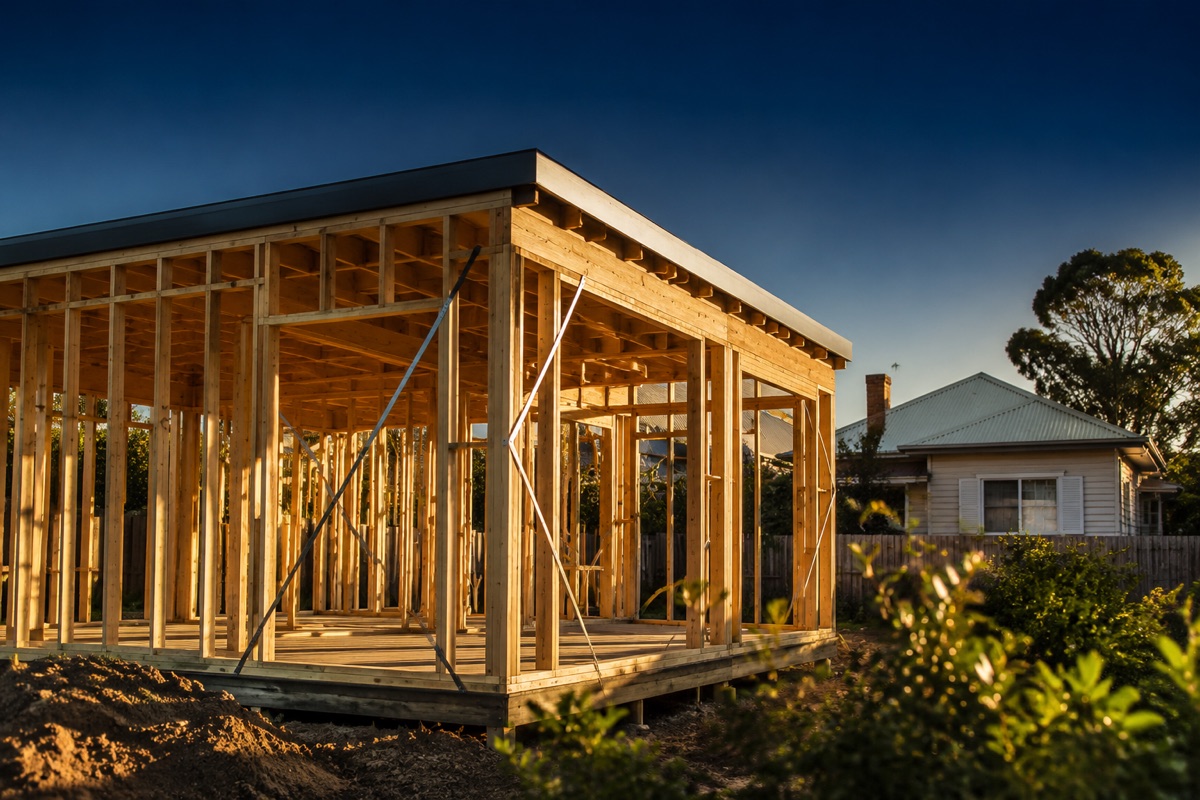
What VC306 changed, and what it left alone
VC306 was gazetted and came into operation on 15 October 2026 [1]. Clause 73.03 now defines a small second dwelling as a building, or part of a building, “with a total floor area not exceeding 80 square metres, on the same lot as an existing dwelling and used as a self-contained residence”, which must include a kitchen sink, food preparation facilities, a bath or shower, and a toilet and wash basin [2]. The area counts every floor of the dwelling, measured from the outside of the external walls or the centre of a party wall, and leaves out attached decks, verandahs, pergolas, porches and other attached roofed or unroofed structures. VC306 also deleted Clause 54.03-5, the planning safety-and-accessibility standard for small second dwellings.
Much did not change. The no-permit conditions in the General Residential Zone (Clause 32.08) — no more than one existing dwelling, only one small second dwelling, no reticulated natural gas — are the same, and a permit is still required on a lot under 300 m² [3]. Overlays still apply. And the building rules have not moved: the Building Regulations 2018 in force on 21 October 2026 (version 031) still define a small second dwelling as a Class 1a building of no more than 60 m² (reg 5(1)) [4]. A building permit is always required, and for a design between 60 and 80 m² the building surveyor decides how it is assessed.
For a rental, the extra 20 m² is the difference between a one-bedroom studio and a home that can take two or three bedrooms or a second bathroom — a different household, a different advertisement and a different set of maintenance items. The build side, step by step, is in our granny flat permit walkthrough.
Which lots qualify — checked in the order a manager asks
Before a design is priced, we work through the same questions for every address, and record each answer with its source and date:
- Zone. Read the planning property report. The conditions above are the General Residential Zone’s; other residential zones carry their own small-second-dwelling provisions and non-residential zones their own rules.
- Lot size. 300 m² or more for the no-permit route in the General Residential Zone [3]. Below that, a permit application.
- Existing dwellings. No more than one, and no other small second dwelling. A garage already converted into a self-contained unit counts.
- Gas. No reticulated natural gas to the new dwelling. Plan heating, hot water and cooking as electric.
- Overlays and title. Heritage, flood, bushfire, vegetation and other overlays can require a permit; a covenant or Section 173 agreement can rule the dwelling out regardless of planning.
- Floor area as drawn. Total floor area to the outside of the external walls, with decks and verandahs excluded. Over 60 m², ask the building surveyor about the building pathway before signing.
- One lot. The definition places the dwelling on the same lot as an existing dwelling; separate title is a subdivision question with its own process.
A lot can pass every planning gate and still be a poor second rental. Check what a second household needs every day: its own entry and lit path, somewhere for bins and mail, parking or a clear reason there is none, private open space, and service access that does not run through the other tenancy.
Before it is advertised: minimum standards, safety checks and records
Since 25 November 2025 a rental property must meet the rental minimum standards at the time it is advertised, not only before the renter moves in, and from 13 October 2026 the rental provider or agent must keep records showing that it did [5, 6]. The standards cover bathrooms, electrical safety, heating, kitchen, laundry, lighting, locks, mould and damp, structural soundness, toilets, ventilation, vermin-proof bins, windows, window coverings and window-covering anchors [5]. A new building is not automatically a compliant rental: the building surveyor’s final inspection records the building, while the minimum-standards record shows the rental — keep both.
Safety checks run on the rental’s own schedule. From 13 October 2026 two-yearly gas and electrical safety checks apply to all rental agreements, and if no check was done in the two years before a renter moves in, one must be arranged as soon as possible [6, 7]. A small second dwelling without reticulated gas may still have bottled-gas appliances, so record what is actually installed. Smoke-alarm safety checks are annual for every rental agreement. Energy-efficiency standards for heating, cooling, hot water, showerheads, insulation and draughtproofing start from 1 March 2027 under their own triggers [6]; specifying an efficient all-electric dwelling now avoids a retrofit later.
The granny flat rental-readiness checklist sets out the full pre-advertising file.
The Residential Tenancies Act duties that come with a second tenancy
A self-contained small second dwelling let to its own household is a separate residential rental agreement under the Residential Tenancies Act 1997 [8, 12] — not a room in the main house. A rooming house is a different regime, which turns on rooms being available for four or more people to rent (see rooming house management). One household renting both dwellings together is a different arrangement; decide which one you are offering before you advertise.
The current rules shape the campaign itself [6]:
- Advertise one price. Rental bidding is banned: a provider cannot accept an offer above the advertised rent.
- Use the prescribed application form (from 31 March 2026), ask only for information needed to assess suitability, identity and ability to pay, and protect what you collect.
- No application or rent-payment fees charged by the provider or agent (from 13 October 2026).
- Bond: no more than one month’s rent unless the weekly rent is over $900; lodge it with the RTBA within 14 days of receipt, and since 9 September 2026 the renter may elect to pay it to the RTBA directly [9].
- Condition report: give the renter two signed copies (or one electronically) before they move in; they return it within five business days. Date and label the photos [10].
- Utilities: with its own electricity or gas meter, the renter pays that service’s supply and usage costs, and with its own water meter the water used and the sewage disposal charge, unless the rental provider agrees to pay (record that as a special condition); where a service is not separately metered, the rental provider pays [11]. A single water meter for the whole title usually means the owner pays the granny flat’s water.
- Ending and changing the tenancy: a notice to vacate needs a valid reason, rent increases need 90 days’ notice, and from 13 October 2026 a bond claim needs advance notice to the renter with supporting evidence [6].
Leasing and managing it: the sequence we follow
For a new 80 m² second dwelling, the handover from builder to renter runs in this order:
- Approval file. Building permit, final inspection or occupancy documents, and the plans as built — matching the address and the 80 m² (or smaller) floor area.
- Tenancy model. Separate agreement or whole-property letting; who uses which outdoor space, parking, bins and mailbox.
- Services map. Which meters exist, who pays which bill under the agreement, and where shared services run. The shared-services evidence guide covers the record.
- Standards and safety record. Minimum standards, electrical and smoke-alarm checks, and any gas appliances — dated, with outstanding items assigned.
- Appraisal. Like-for-like current evidence for the actual dwelling and terms, labelled as asking evidence until a lease is signed. A builder’s or owner’s target is an assumption, not a comparable.
- Campaign and applications. One advertised price, the prescribed form, the same screening basis for every applicant.
- Start of tenancy. Agreement, bond lodgement, condition report with dated photos, keys and service instructions.
- Ongoing management. Routine inspections, repairs, annual smoke-alarm checks, two-yearly gas and electrical checks, and the March 2027 energy-efficiency triggers. Tell the insurer the second dwelling is let; check the policy for the actual use.
OptimaRea’s published fee for a main house plus granny flat is the dual-occupancy tier, 6.90% + GST of rent collected; the letting fee is 1–2 weeks’ rent and REA advertising $217–$280 + GST, with the complete scope set out in the written engagement.
What OptimaRea’s managed data shows — and what it cannot
OptimaRea publishes its connected portfolio on the leasing dashboard. In the snapshot of 19 October 2026 (PropertyMe rental records joined to the rental operations register):
- 34 managed rental units were in the granny-flat category, at 34 street-address groups; 27 of them had a verified active tenancy.
- The mean current contracted rent of those 27 occupied granny-flat units was $347.72 a week (weekly equivalent: monthly rent × 12 ÷ 52).
- Across 25 verified main-house + granny-flat address pairs — out of 34 managed granny-flat addresses — the mean combined current contracted rent was $904.29 a week.
Every figure is a gross contracted rent for existing leases, before vacancy, management fees, maintenance, rates, insurance, finance and tax. It is not collected cash, not a yield and not a forecast for another property.
What the data cannot tell you matters as much. The dashboard does not classify the managed granny flats by floor area, so it cannot show what an 80 m² dwelling rents for compared with a 60 m² one. It contains no dwelling approved under VC306: the rule began four days before the snapshot. It has no vacancy-rate, net-income or yield measure. The granny flat page shows the owner’s target for an 80 m² home ($600 a week, set 17 October 2026) — an illustrative gross assumption, not an observed rent. When a VC306 dwelling joins the managed portfolio, it will appear in the dashboard under the same definitions, with its own date and sample.